Copyright © 2026 LP Fintech. All rights reserved.
Blog
Why UPI Transactions Fail, and How Smart Routing Recovers Lost Revenue
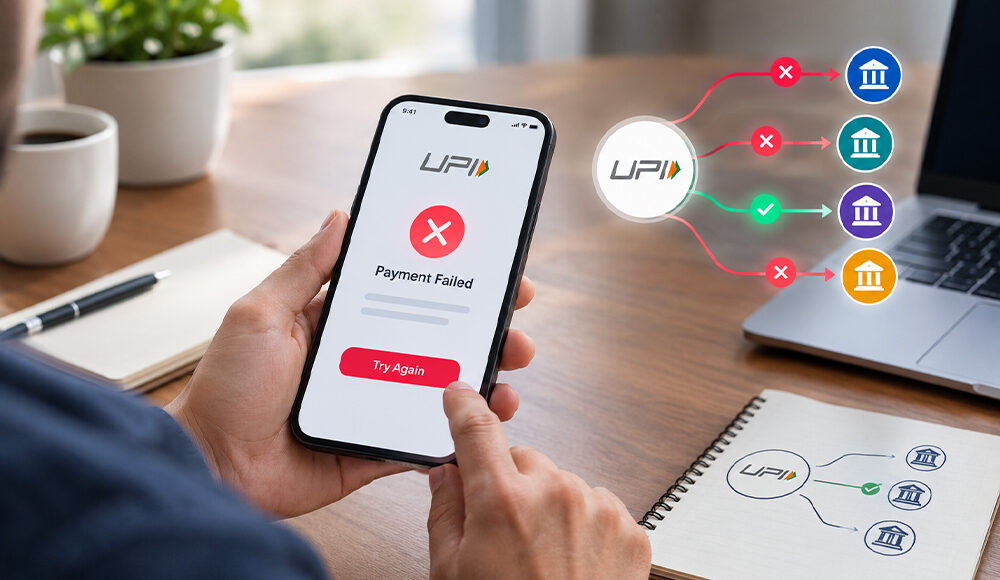
UPI is now the default way India pays. According to NPCI data, UPI processed a record 24.51 billion transactions worth ₹29.82 lakh crore in August 2026, averaging roughly 791 million transactions a day.
At that scale, even a small failure rate is a big number. And for payment service providers, fintechs and merchant aggregators, every failed transaction is more than a bad customer experience. It is lost revenue, a support ticket, a reconciliation headache and, often, a customer who simply doesn’t come back.
The good news: a large share of UPI transaction failures are not caused by the customer. They are technical failures, and many of them can be reduced with the right routing and orchestration layer.
This guide explains why UPI transactions fail, which failures you can actually fix, and how smart payment routing helps businesses recover revenue they are currently losing without noticing.
The hidden cost of a “small” failure rate
Failure rates look harmless on a dashboard. A 1% or 2% dip rarely triggers alarms. But the maths changes quickly at volume.
An illustrative example: a merchant aggregator processes 10 lakh UPI transactions a day at an average ticket size of about ₹1,200 (close to the national UPI average in August 2026).
- Improving the success rate by just 1 percentage point recovers 10,000 transactions a day
- That is roughly ₹1.2 crore in payment volume every day
- Or about ₹36 crore a month that would otherwise have been abandoned, retried elsewhere or lost to a competitor
And the cost isn’t only GMV. Every failure also creates:
- Customer drop-off: many users don’t retry after one failed payment
- Support load: “money debited but order not confirmed” is one of the most common complaints in Indian payments
- Reconciliation effort: pending and deemed-success transactions need manual follow-up
- Merchant churn: merchants move to whichever aggregator “just works”
This is why leading PSPs treat success rate as a core business metric, not an IT metric.
Why UPI transactions fail: the two categories that matter
Not every failure is fixable. The first step is separating failures into two buckets.
1. Business declines (customer-side)
These happen because of something on the payer’s side:
- Insufficient balance
- Wrong UPI PIN or too many PIN attempts
- Daily or per-transaction limit exceeded
- Customer cancels or lets the collect request expire
- Account frozen, blocked or inactive
No routing logic can fix these. The right response is clear messaging so the customer knows exactly what to do next.
2. Technical declines (system-side)
These happen somewhere in the chain between the payer’s app, the PSP, the payment gateway, NPCI, the remitter bank and the beneficiary bank:
- Issuer or remitter bank downtime: the payer’s bank is slow or unavailable
- Beneficiary bank or acquirer issues: the receiving side times out
- Payment gateway or PSP downtime: your provider has a partial or full outage
- Timeouts and “pending” status: the transaction neither succeeds nor fails cleanly within the response window
- Network and integration errors: dropped connections, malformed requests, expired tokens
Technical declines are where businesses lose money they should not be losing, and where smart routing makes the biggest difference.
The problem with a single payment gateway
Most businesses start with one payment gateway. It is simple, and it works, until it doesn’t.
With a single-PG setup:
- When your PG has an outage, your checkout goes down with it. There is nowhere else for the transaction to go.
- You can’t see performance differences. One PG may perform better on HDFC-issued VPAs, another on SBI or cooperative bank accounts. With one provider, you never find out.
- You pay whatever MDR you are given. There is no alternative to route lower-value or high-volume traffic through.
- Your success rate is only as good as your weakest dependency.
This is the gap payment orchestration was built to close.
What smart payment routing actually does
A payment orchestration layer sits between your business and multiple payment gateways or PSPs. Instead of sending every transaction down one fixed path, it decides the best path for each individual transaction, in real time.
1. Success-rate-based routing
The orchestration layer continuously tracks live success rates by gateway, by issuer bank and by payment method. If Gateway A is currently performing better for a particular bank’s customers, traffic for that bank is steered there automatically.
2. Real-time failover
When a gateway starts timing out or its success rate drops below a threshold, traffic shifts to a healthy route within seconds, before your customers or your support team notice.
3. Cost-aware routing (MDR optimisation)
Not every transaction needs the same route. Orchestration can route by MDR, ticket size, uptime and geography, balancing cost against reliability instead of treating them as a trade-off you make once and forget.
4. Smart retries, done safely
Retrying a failed payment through an alternate route can rescue a transaction, but only if it is done carefully. A good orchestration layer uses idempotency checks and status verification so a customer is never charged twice for the same order.
5. Payment method cascading
Some failures can’t be routed around. If the payer’s own bank is down, no UPI route will help. In those cases, the right move is to offer an alternative instantly: card, net banking or another UPI handle, instead of showing a dead-end error.
6. Unified reconciliation and settlement
Multiple gateways usually mean multiple settlement files, formats and timelines. Orchestration brings multi-PG reconciliation into one view, so finance teams can match every transaction, resolve pending ones faster and close the books without spreadsheets.
Single gateway vs payment orchestration: a quick comparison
| Single payment gateway | Payment orchestration layer | |
| Gateway outage | Checkout goes down | Automatic failover to a healthy route |
| Routing logic | One fixed path | Per-transaction routing by success rate, MDR, uptime, geography |
| Visibility | One provider’s view | Success rates compared across providers and banks |
| Cost control | Fixed MDR | Route traffic to optimise cost |
| Reconciliation | One file per provider | Unified multi-PG reconciliation |
| Vendor dependency | High lock-in | Switch or add providers without re-integration |
How to measure whether routing is working
If you are evaluating or running a routing layer, track these metrics every week:
- Overall success rate: split by business vs technical declines
- Technical decline rate by issuer bank: shows where routing helps most
- Success rate by gateway / PSP: shows which routes to prioritise
- Pending / deemed transactions: and how quickly they resolve
- Recovery rate on retries: transactions saved after a first failure
- Effective MDR: average cost per successful transaction, not per attempt
The goal is not zero failures. It is zero avoidable failures.
Checklist: choosing a payment orchestration partner in India
Before you sign with an orchestration provider, ask:
- Do you have tie-ups with multiple RBI-authorised payment aggregators / gateways?
- Can routing rules use success rate, MDR, uptime and geography, and can we configure them ourselves?
- How fast does failover trigger, and is it automatic?
- How do you prevent double debits on retries?
- Do you offer multi-PG reconciliation and unified settlement?
- Do we get live dashboards for success rates by bank and gateway?
- Is the platform PCI DSS compliant and aligned with RBI and NPCI guidelines?
- Can it be white-labelled under our brand?
- How long does go-live take?
How LP Fintech helps
LP Fintech’s Payment Orchestration & Gateway service is built for exactly this problem. It connects businesses to multiple RBI-approved payment aggregator tie-ups through a single integration, with:
- Smart routing by MDR, uptime and geography
- Real-time failover when a route degrades
- Multi-PG reconciliation and unified settlement
- Merchant onboarding built into the same stack
- Live dashboards for success rates, uptime and fraud alerts
Because it is modular, you can start with orchestration alone and add the UPI Switch, Verification Suite or white-label platform later, without rebuilding your stack.
Losing transactions you shouldn’t be? Talk to the LP Fintech payments team for a routing assessment of your current setup.
Frequently asked questions
Why do UPI transactions fail even when the customer has enough balance?
Most such failures are technical declines: the payer’s bank, the beneficiary bank, the payment gateway or the network timed out or was unavailable. These are system-side issues, not problems with the customer’s account.
What is the difference between a business decline and a technical decline?
A business decline is caused by the customer, such as a wrong PIN, insufficient funds or an exceeded limit. A technical decline is caused by the payment infrastructure, such as bank downtime, gateway outages or timeouts. Smart routing can reduce technical declines, not business declines.
What is payment orchestration?
Payment orchestration is a layer that connects a business to multiple payment gateways or PSPs and decides the best route for each transaction in real time, based on factors like success rate, cost, uptime and geography. It also handles failover and unified reconciliation.
Can smart routing cause a customer to be charged twice?
Not if it is built correctly. A well-designed orchestration layer uses idempotency and status checks before retrying, so a transaction is only completed once.
Who needs payment orchestration?
Any business processing meaningful payment volume through more than one rail or provider: PSPs, fintech apps, merchant aggregators, NBFCs running collections and large merchants. The higher your volume, the more each percentage point of success rate is worth.
How long does it take to set up payment orchestration?
It depends on the provider and your existing stack. With pre-built gateway integrations and REST APIs, many institutions go live in a matter of weeks rather than months.
Source for UPI volume data: National Payments Corporation of India (NPCI), August 2026 statistics.