Copyright © 2026 LP Fintech. All rights reserved.
Blog
KYC Failures Are a Lending Problem, Not Just a Compliance Problem
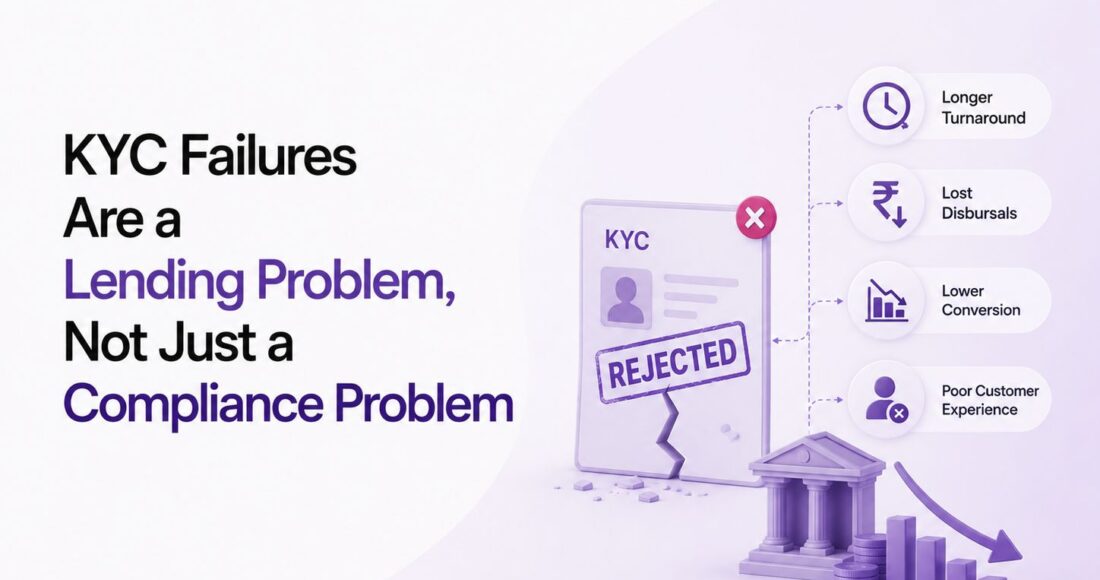
When a loan application fails, the assumption is usually that the borrower did not qualify. But a significant share of digital lending rejections in India have nothing to do with creditworthiness. They happen because the user never made it through verification.
Research on digital onboarding across fintech platforms consistently shows 40 to 50 percent of users abandoning during KYC steps. A separate analysis of banking app onboarding found that up to 60 percent of users abandon before completing identity verification. These are not users who were declined. They are users who gave up.
The Cost of Acquisition, Paid Twice
There is a financial framing that makes this problem concrete. Customer acquisition in digital lending is expensive. Performance marketing, referral programs, and organic channels all cost money to run. When a user who has been acquired through those channels abandons during Aadhaar OTP verification or drops off because the video KYC agent is not available, that acquisition cost is entirely sunk.
The user you already paid to acquire is gone. Not because your credit model rejected them. Because the API underneath your onboarding flow failed them.
Where the Drop-offs Actually Happen
The failure points in a typical Indian NBFC or lending platform onboarding flow are well-documented:
Aadhaar OTP timeout. The OTP does not arrive, or arrives after the session has already expired. The user tries once or twice and closes the app.
PAN name mismatch. The name on the PAN card differs slightly from what the user typed. The system returns a hard failure. Most users do not know how to resolve this.
Bank account verification delay. Manual or slow API verification takes hours. Users who apply in the evening find out the next morning whether their account was verified, at which point many have moved on.
Video KYC unavailability. If the video KYC service only staffs agents during business hours, a user who applies at 11 PM cannot complete onboarding. That session is lost.
Each of these is a solvable infrastructure problem. None of them are inherent to the lending product itself.
What Good Verification Infrastructure Looks Like
The standard to aim for is near-zero drop-off from verification-related failures specifically. That means OTP paths that work reliably, with fallback options when they do not. It means name matching that handles common variations rather than returning hard failures. It means bank verification that runs in seconds, not hours. It means video KYC that is available around the clock.
It also means having all of these under a single API with consistent behavior, so debugging a failure does not require contacting three different vendors.
The Business Case
Improving KYC completion rates has a direct and measurable impact on lending volumes. If a platform is processing 10,000 loan applications per month and 40 percent are dropping off during KYC, bringing that drop-off rate down to 15 percent represents a material increase in disbursements from the same acquisition spend.
The verification API is not a compliance checkbox. It is a conversion tool.
LP Fintech’s Verification Suite covers every component of this stack: Aadhaar OTP and Offline XML, PAN with name match, penny drop and pennyless bank verification, 24/7 RBI V-CIP compliant Video KYC, face match with liveness detection, OCR document extraction, and CKYC fetch and upload. One API, one integration, one support line.
The users you paid to acquire should make it through. The verification infrastructure is the part that determines whether they do.